 Date
Date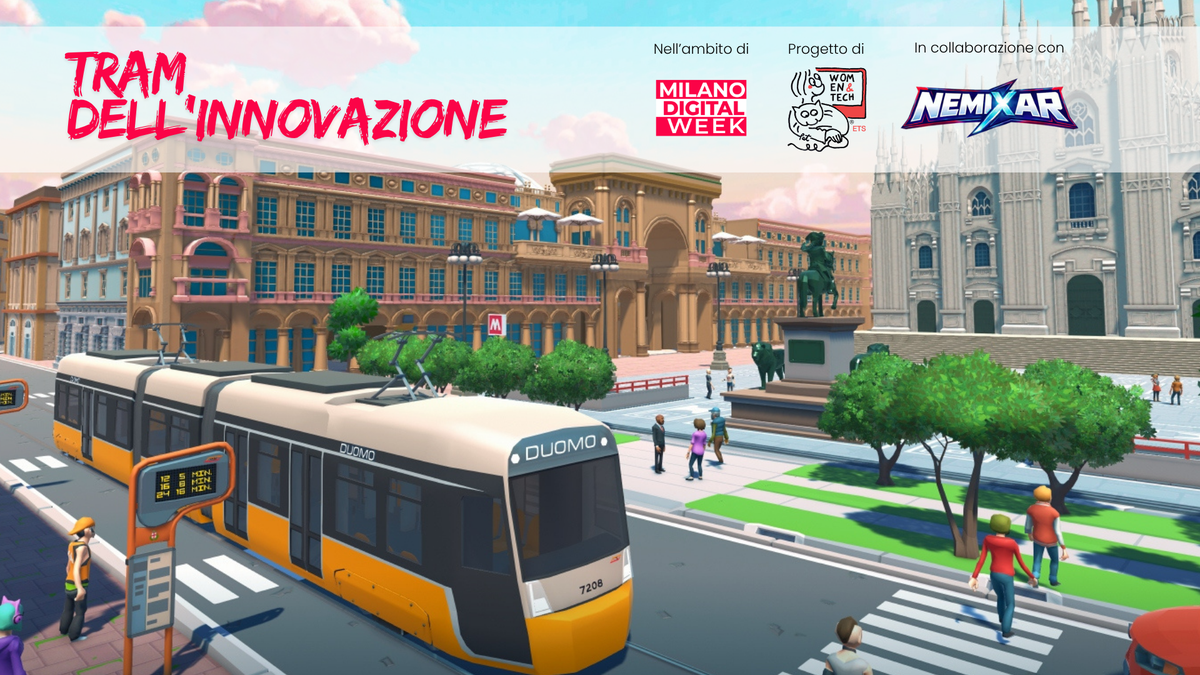
People, skills, and technologies on a journey towards the generative city
Born in 2018 from an idea by Gianna Martinengo, President of Women&Tech® ETS, the Tram of Innovation® is a place for meeting, discussion, and discovery dedicated to the transformations that digital technology brings to people's lives, work, businesses, and society.
Edition after edition, the Tram has accompanied citizens and new generations through the major technological changes of our time, fostering dialogue among businesses, institutions, universities, research, professionals, and young people. A journey not only through future scenarios but above all among experiences, ideas, and concrete solutions capable of showing how innovation can generate new opportunities and help improve the quality of life.
Over time, the Tram has also transformed: from traveling aboard the historic Milanese tram to digital events, up to its evolution in the Metaverse, an immersive and accessible space where people can meet, share knowledge, and experience new ways of participating.
On the occasion of Milano Digital Week 2026, the Innovation Tram interprets the theme “The Generative City” by focusing on the ability of people, skills, technologies, and relationships to create the future.
A generative city is not simply a more technological city. It is a city capable of creating connections, opportunities, knowledge, and shared value, linking human and artificial intelligence and using innovation in a conscious, sustainable, and inclusive way.
The Innovation Tram 2026 thus becomes an open space to explore the transformations that are reshaping work, skills, training, health and well-being, mobility, sustainability, inclusion, culture, and new models of relationships, through testimonies, conversations, experiences, and perspectives from different worlds.
A journey that combines tradition and innovation, physical and digital dimensions, experience and future, with a conviction that has accompanied the project since its inception: technology generates genuine progress when it manages to connect people, expand possibilities, and transform knowledge into opportunities for everyone.
Because the city of the future is not built only with new technologies.
It is created together.


Program
Discover the full event schedule, session times, topics, and keynote speakers.
Data centers are the infrastructure on which every promise of generative artificial intelligence rests: without them, the city of the future does not exist. But building, powering, financing, and managing them is a challenge that spans different sectors, skills, and disciplines.
In this meeting – hosted by the law firm Gitti and Partners and open to voices from the entire supply chain – we bring together those who design and provide the technology, those who invest in and finance the infrastructures, those who use them, and those who oversee their regulatory implications.
The goal is to build a dialogue among industry operators to understand how Milan and Italy are positioning themselves in one of the most decisive economic and geopolitical challenges of the coming years.
In a time when knowledge work is increasingly influenced by technology, artificial intelligence, and information overload, understanding what nourishes and protects our mind becomes an ever more important skill. Essayist Eliana Liotta and neuroscientist Michela Matteoli tell this story in the staged lecture based on their bestseller La mente radiosa (Sonzogno, 2026), created in collaboration with the Piccolo Teatro di Milano.
Through a literary and scientific dialogue, the authors take the audience on a journey through thoughts, feelings, and foods that nourish our intelligence and brighten life.
Interspersed with their words, and amplifying their meaning, are passages from Johann Sebastian Bach's Suites for Solo Cello: music supported by a rational architecture yet at the same time deeply emotional, in a sort of echo of the structure of the narrated text. The bare voices of the authors and the instrument intertwine to remind us that our brain continuously changes as we live and that we can always become better people.
As Corriere della Sera wrote, the essay The Radiant Mind explains that "the health and longevity of the brain depend on both material and immaterial nourishment" and that "we are the result of every shared dinner, every laugh, every love."
Artificial intelligence is entering the core of knowledge professions, transforming activities, skills, decision-making processes, and organizational models. Based on the book The White-Collar Revolution by Silvia Migliavacca, the event offers a reflection on what it means to work and lead organizations in the AI era.
The challenge is not only to learn how to use new tools, but to unlearn and relearn, rethinking the boundary between what can be delegated to technology and what requires human judgment, experience, and responsibility.
From individual productivity to process redesign, from the evolution of skills to the future of young professionals, up to the topics of governance, sustainability, and responsibility: a conversation to understand how AI can become not just a simple accelerator of the existing, but an opportunity to redesign the work and the organizations we want to build.
Artificial intelligence is changing work not in a distant future, but already today: in processes, roles, required skills, and career paths. The question, therefore, is not only whether artificial intelligence will replace certain tasks, but how it will change our way of working and what will be needed to remain relevant.
The roundtable compares different and complementary perspectives to understand which skills are making a difference and how we can prepare for a market increasingly influenced by Artificial Intelligence.
A discussion to move beyond the narrative of artificial intelligence stealing our jobs and understand how to work with this technology, enhancing what remains human. The goal is to provide professionals, managers, and new generations with concrete insights to use artificial intelligence as an ally and continue to be relevant in a changing world of work.
Data centers are the infrastructure on which every promise of generative artificial intelligence rests: without them, the city of the future does not exist. But building, powering, financing, and managing them is a challenge that spans different sectors, skills, and disciplines.
In this meeting – hosted by the law firm Gitti and Partners and open to voices from the entire supply chain – we bring together those who design and provide the technology, those who invest in and finance the infrastructures, those who use them, and those who oversee their regulatory implications.
The goal is to build a dialogue among industry operators to understand how Milan and Italy are positioning themselves in one of the most decisive economic and geopolitical challenges of the coming years.
This conversation between Stefano A. Cerri and Claude Frasson aims to illustrate the evolution of Artificial Intelligence in the transmission of knowledge.
The first studies in this field led to the development of successive generations of intelligent tutoring systems, designed to convey knowledge taking into account the learner's level of preparation, the adopted pedagogical strategy, and the expected qualification level.
With the rapid development of Artificial Intelligence and deep learning, a new era is beginning. This approach allows for the automatic construction of knowledge and support tools based on artificial dialogues that provide an appearance of personalization.
The conversation will allow for an understanding of the evolution of knowledge transmission, the opportunities, challenges, and risks of this new artificial world, as well as its possible impacts on human society.
Artificial intelligence is taking on new forms: no longer just chatbots or text assistants, but faces, voices, and personalities capable of connecting with people. Conversational avatars are becoming new interfaces between brands and audiences, present on websites as well as in stores, kiosks, interactive windows, and events.
The real challenge, however, is not only technological. It is above all a matter of experience and strategic direction: what face to give a brand? What voice, what language, what personality? And how to ensure consistency between identity, values, and the relationship with the audience?
The meeting explores how conversational avatars are redesigning the phygital experience, transforming the touchpoints between physical and digital spaces into increasingly natural, personalized, and engaging opportunities for dialogue. A reflection on how to design these new digital presences by focusing not on the technology itself, but on the quality of the relationship they are able to generate.
In a time when knowledge work is increasingly influenced by technology, artificial intelligence, and information overload, understanding what nourishes and protects our mind becomes an ever more important skill. Essayist Eliana Liotta and neuroscientist Michela Matteoli tell this story in the staged lecture based on their bestseller La mente radiosa (Sonzogno, 2026), created in collaboration with the Piccolo Teatro di Milano.
Through a literary and scientific dialogue, the authors take the audience on a journey through thoughts, feelings, and foods that nourish our intelligence and brighten life.
Interspersed with their words, and amplifying their meaning, are passages from Johann Sebastian Bach's Suites for Solo Cello: music supported by a rational architecture yet at the same time deeply emotional, in a sort of echo of the structure of the narrated text. The bare voices of the authors and the instrument intertwine to remind us that our brain continuously changes as we live and that we can always become better people.
As Corriere della Sera wrote, the essay The Radiant Mind explains that "the health and longevity of the brain depend on both material and immaterial nourishment" and that "we are the result of every shared dinner, every laugh, every love."
On the seventieth anniversary of the historic Dartmouth conference, where the term “Artificial Intelligence” was introduced, the conversation between Stefano A. Cerri and Enrico Motta will retrace the evolution of AI, starting from the “General Problem Solvers” of the 1960s, continuing with knowledge representation, ontologies, and intelligent systems, and arriving at the Large Language Models that dominate the current landscape. In particular, a key topic to be addressed concerns the relationship between traditional AI, which is based on explicit and formal models of knowledge representation and reasoning, and modern AI, which instead relies on multidimensional statistical models applied to an enormous amount of data. AI requires reliable knowledge, context, and also robust capabilities for explanation, interpretation, and interaction. LLMs are criticized for their lack of transparency and reliability—limitations that entail very serious risks, given the level of sophistication of current models. Therefore, during the debate, it will be discussed whether these limitations of current LLMs introduce the need to reconsider the elements of representation and reasoning that define traditional AI.
This conversation between Stefano A. Cerri and Claude Frasson aims to illustrate the evolution of Artificial Intelligence in the transmission of knowledge.
The first studies in this field led to the development of successive generations of intelligent tutoring systems, designed to convey knowledge taking into account the learner's level of preparation, the adopted pedagogical strategy, and the expected qualification level.
With the rapid development of Artificial Intelligence and deep learning, a new era is beginning. This approach allows for the automatic construction of knowledge and support tools based on artificial dialogues that provide an appearance of personalization.
The conversation will allow for an understanding of the evolution of knowledge transmission, the opportunities, challenges, and risks of this new artificial world, as well as its possible impacts on human society.
Data centers are the infrastructure on which every promise of generative artificial intelligence rests: without them, the city of the future does not exist. But building, powering, financing, and managing them is a challenge that spans different sectors, skills, and disciplines.
In this meeting – hosted by the law firm Gitti and Partners and open to voices from the entire supply chain – we bring together those who design and provide the technology, those who invest in and finance the infrastructures, those who use them, and those who oversee their regulatory implications.
The goal is to build a dialogue among industry operators to understand how Milan and Italy are positioning themselves in one of the most decisive economic and geopolitical challenges of the coming years.
Artificial intelligence is changing work not in a distant future, but already today: in processes, roles, required skills, and career paths. The question, therefore, is not only whether artificial intelligence will replace certain tasks, but how it will change our way of working and what will be needed to remain relevant.
The roundtable compares different and complementary perspectives to understand which skills are making a difference and how we can prepare for a market increasingly influenced by Artificial Intelligence.
A discussion to move beyond the narrative of artificial intelligence stealing our jobs and understand how to work with this technology, enhancing what remains human. The goal is to provide professionals, managers, and new generations with concrete insights to use artificial intelligence as an ally and continue to be relevant in a changing world of work.
Artificial intelligence is entering the core of knowledge professions, transforming activities, skills, decision-making processes, and organizational models. Based on the book The White-Collar Revolution by Silvia Migliavacca, the event offers a reflection on what it means to work and lead organizations in the AI era.
The challenge is not only to learn how to use new tools, but to unlearn and relearn, rethinking the boundary between what can be delegated to technology and what requires human judgment, experience, and responsibility.
From individual productivity to process redesign, from the evolution of skills to the future of young professionals, up to the topics of governance, sustainability, and responsibility: a conversation to understand how AI can become not just a simple accelerator of the existing, but an opportunity to redesign the work and the organizations we want to build.
On the seventieth anniversary of the historic Dartmouth conference, where the term “Artificial Intelligence” was introduced, the conversation between Stefano A. Cerri and Enrico Motta will retrace the evolution of AI, starting from the “General Problem Solvers” of the 1960s, continuing with knowledge representation, ontologies, and intelligent systems, and arriving at the Large Language Models that dominate the current landscape. In particular, a key topic to be addressed concerns the relationship between traditional AI, which is based on explicit and formal models of knowledge representation and reasoning, and modern AI, which instead relies on multidimensional statistical models applied to an enormous amount of data. AI requires reliable knowledge, context, and also robust capabilities for explanation, interpretation, and interaction. LLMs are criticized for their lack of transparency and reliability—limitations that entail very serious risks, given the level of sophistication of current models. Therefore, during the debate, it will be discussed whether these limitations of current LLMs introduce the need to reconsider the elements of representation and reasoning that define traditional AI.
Artificial intelligence is taking on new forms: no longer just chatbots or text assistants, but faces, voices, and personalities capable of connecting with people. Conversational avatars are becoming new interfaces between brands and audiences, present on websites as well as in stores, kiosks, interactive windows, and events.
The real challenge, however, is not only technological. It is above all a matter of experience and strategic direction: what face to give a brand? What voice, what language, what personality? And how to ensure consistency between identity, values, and the relationship with the audience?
The meeting explores how conversational avatars are redesigning the phygital experience, transforming the touchpoints between physical and digital spaces into increasingly natural, personalized, and engaging opportunities for dialogue. A reflection on how to design these new digital presences by focusing not on the technology itself, but on the quality of the relationship they are able to generate.
In a time when knowledge work is increasingly influenced by technology, artificial intelligence, and information overload, understanding what nourishes and protects our mind becomes an ever more important skill. Essayist Eliana Liotta and neuroscientist Michela Matteoli tell this story in the staged lecture based on their bestseller La mente radiosa (Sonzogno, 2026), created in collaboration with the Piccolo Teatro di Milano.
Through a literary and scientific dialogue, the authors take the audience on a journey through thoughts, feelings, and foods that nourish our intelligence and brighten life.
Interspersed with their words, and amplifying their meaning, are passages from Johann Sebastian Bach's Suites for Solo Cello: music supported by a rational architecture yet at the same time deeply emotional, in a sort of echo of the structure of the narrated text. The bare voices of the authors and the instrument intertwine to remind us that our brain continuously changes as we live and that we can always become better people.
As Corriere della Sera wrote, the essay The Radiant Mind explains that "the health and longevity of the brain depend on both material and immaterial nourishment" and that "we are the result of every shared dinner, every laugh, every love."
