


Intelligence that cannot be delegated: women, sustainability, and equality in the era of AI
13/11/2026
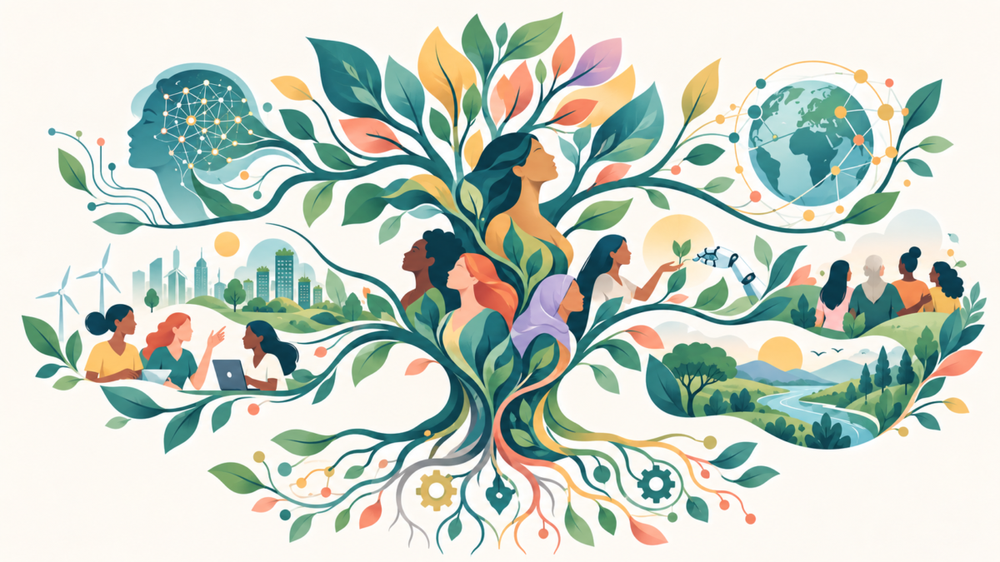
Sustainability is everywhere, yet the crisis advances. This is the paradox worth starting from, because it reveals something that concerns all of us: sustainability has become an overused word. CO₂, ESG, greenwashing — it is measured, reported, but often not lived. There is another path, and it is the one indicated by Pope Francis in Laudato Si' (2015) and in Laudate Deum (2023): integral ecology. Not just the environment, but relationships — between people, between generations, between humanity and the earth. "Everything is connected," writes Francis. It is not a moral appeal, it is a paradigm shift. Integrated sustainability calls for putting care back at the center as an operational value, not a sentimental one. Traditional ESG remains necessary, but not enough: they measure environmental impact without questioning the quality of relationships, the long term, or the non-immediate consequences.
The role of women in this broader vision
Women are not "more sustainable" by nature. But they bring to organizations a posture oriented towards systemic care, the long term, and non-obvious connections — exactly what integrated sustainability requires. It is from this awareness that Women&Tech® was born in 1999, as a social responsibility project of DKTS, later becoming an association in 2009 and then in 2022 a Third Sector Entity (ETS) registered with RUNTS. The mission has been clear from the start: women should not be inserted into innovation — they should be recognized as agents of innovation with their own vision. The problem, after all, has never been the lack of competent women. It is the lack of organizations capable of valuing that competence.
For an industrial company, sustainability cannot be reduced to energy efficiency or a green supply chain. It also means: how are decisions made? Who is at the table? What time horizons are considered? Women in leadership positions do not just change the quotas — they change the questions being asked. And it is the right questions that produce lasting solutions.
Artificial intelligence is not neutral
Artificial intelligence is often presented as the key tool for sustainability and equality. But systems reflect the priorities, values, and biases of those who design them and those who commission their development. A system trained on a fragmented view of sustainability, or society, will optimize that fragmentation — faster, and on a global scale.
The right question, then, is not "will AI help us be sustainable, or more fair?", but: who decides what a system considers sustainable, fair, worthy? Every technological revolution changes the tools we work with. Artificial intelligence is doing something more: it is changing the way we make decisions, assign value, distribute opportunities, and build trust. For this reason, the issue of equality is destined to become one of the central themes in the debate on AI. For many years we considered technology as a neutral factor, simply capable of increasing process efficiency. Today we know this is not the case: modern computing has become a social phenomenon. Algorithms do not just organize information: they organize relationships, influence behaviors, modify the functioning of organizations, and increasingly affect the exercise of rights.
Those who, like me, have been involved in artificial intelligence since the 1980s, when this discipline was still predominantly academic and interdisciplinary research, have seen its nature change profoundly: from the problem of representing knowledge and supporting human reasoning, to understanding how increasingly autonomous systems influence society. Artificial intelligence was born from the meeting of computer science and cognitive sciences, and this dual nature still characterizes it today: on one hand algorithms, mathematical models, and computing power; on the other hand people, decision-making processes, organizations, and social contexts. Separating them means understanding only half of the problem.
The risk of biases and transparency as a right
Equality does not depend solely on the quality of algorithms, but on the quality of the relationships they help to build. Consider the systems used in credit, insurance, healthcare, personnel selection, or access to public services: whenever an algorithm helps to classify a person, assign them a score, or suggest a decision, it indirectly influences the distribution of opportunities.
Here the theme of biases emerges. Algorithms learn from data, but data is not an objective snapshot of reality: it tells the story of society, with its inequalities, its exclusions, its stereotypes. If in the past some categories had fewer opportunities to access credit, work, or education, a system trained on historical data risks considering that inequality a regularity to confirm, not a problem to correct. The algorithm is not discriminatory because it "wants" to discriminate: it becomes so because it learns from a reality that was already discriminatory. And this is one of the most delicate aspects of AI: its apparent objectivity can make inequalities less visible rather than eliminate them.
For this reason, the issue of equality cannot be entrusted solely to developers. It concerns jurists, economists, sociologists, psychologists, philosophers, educators, institutions, businesses, and social partners: an interdisciplinary governance is needed. In the process that led to the European AI Act, to which I contributed within the work of the STOA of the European Parliament, this awareness emerged strongly: some systems must be considered high-risk not so much because of technological sophistication, but because of their impact on people's fundamental rights. The point is not to stop innovation, but to make it reliable — with human supervision, accountability, traceability, preventive risk assessment, continuous monitoring, and transparency.
Among these principles, Explainable AI deserves attention, often reduced to a technical problem — making the functioning of an algorithm understandable. Its meaning is deeper: explainability is a democratic right. When a person receives a decision that affects their life — a denied loan, a rejected insurance policy, an excluded application — they must be able to understand the criteria that contributed to it: not every formula of the model, but the reasoning that produced that outcome. Transparency thus becomes a form of respect for the individual.
Intelligence that is not delegated
There is also a less discussed but equally relevant risk: what I call "cognitive offloading." The more we delegate analysis, memory, and decision-making tasks to algorithms, the more we risk reducing the exercise of our cognitive abilities. The convenience of delegation can slowly turn into dependence. For this reason, I consider it essential to develop what I call cognitive flexibility: the ability to collaborate with intelligent systems while maintaining critical autonomy, evaluative spirit, and personal responsibility. Artificial intelligence should expand our capabilities, not replace our ability to think. There is an intelligence that cannot be delegated: the ability to make sense, to ask the right questions even before seeking answers. It is also, ultimately, a matter of cognitive sovereignty — deciding ourselves, as a society, which values a system should embody, rather than having them imposed on us.
For this reason, women must be within the design of artificial intelligence — not as end users, not as targets of inclusion policies, but as architects of the values that systems embody. Sustainability integrated in the AI era means designing systems that consider the impact on relationships, communities, future generations — not just process efficiency.
An alliance between generations and between intelligences
Work is also changing profoundly. For years we have debated whether AI would replace people; today the question is different: what professional skills will be necessary in an organization where humans and algorithms decide together? No longer technological skills versus humanistic skills, but multiple intelligences: technical, certainly, but also ethical, relational, organizational, legal, and social.
And this is where the alliance between generations takes on a strategic value. The new generations bring familiarity with digital tools; the more experienced generations hold contextual knowledge, organizational memory, the ability to interpret complex situations, and take on responsibility. Equality is built by making these skills interact, not by opposing them — just as it is built by making male and female perspectives interact at the table where systems are designed.
From Francis to Leo XIV: a doctrine that continues
This reading does not arise in isolation. Pope Leo XIV has made artificial intelligence one of the central themes of his pontificate, dedicating to it the first encyclical, Magnifica Humanitas, and choosing a name that explicitly recalls the Rerum Novarum of Leo XIII: just as that text addressed the first industrial revolution, today the Church offers its heritage of social doctrine to respond to this new technological revolution. It is not a break from Laudato Si', but a continuity that is updated: from integral ecology to integral intelligence, the common thread remains the same — everything is connected, and no innovation can be evaluated separately from its impact on people and relationships.
Pope Leo XIV warns against the risk of building "a new Tower of Babel where power, efficiency, and control obscure the face of the human person," and reminds us that "the world does not need artificial intelligence that diminishes humanity." These words directly engage with the theme of this reflection: technology must remain a tool in the service of the integral development of the person, not a system that reduces them to data. The Pope calls for clear legal frameworks that protect rights, privacy, and transparency, and warns of the risk that AI may create new forms of technological dependence between those who design the systems and those who are subjected to them — a gap that risks turning innovation into a form of global imbalance, rather than a lever of equity.
It is the same question I asked earlier, applied on a planetary scale: who sits at the table where it is decided what a system considers right, sustainable, humane? The social doctrine of the Church, from Francis to Leo XIV, offers here a criterion of discernment that goes beyond technique: inviolable dignity of the person, common good, universal destination of goods, subsidiarity, solidarity. Ancient principles, applied to a new challenge — and which confirm that the real stake of artificial intelligence is never only technological.
Who sits at the table
Pope Francis wrote that the ecological crisis is also a crisis of relationships. Artificial intelligence, if poorly designed, risks worsening it: it optimizes, disconnects, speeds up — without care. If well designed — with an integrated vision, female presence at the decision-making tables, interdisciplinary governance, and transparency — it can instead become a tool for systemic care, connection, and equity.
No algorithm will ever be able to guarantee a fairer society on its own. Equality does not come from technology: it comes from the choices we make in designing, regulating, and using it. The fundamental question is not how intelligent artificial intelligence will be, but whether we will be smart enough to use it to build a fairer, more inclusive society that is better able to value every person.
Sustainability integrated in the AI era is not a technical issue. It is a matter of who sits at the table, and with what vision — because the real test of artificial intelligence will not be to imitate the human being, but to strengthen what makes a society authentically human: dignity, responsibility, freedom, equality.
