Ontology of trust
16/11/2026

Here I bring my reflection on trust and whether there is a way to generate and increase it.
It is the result of my introspection and analysis of my experience, and I know that for other people it could be very different. However, I believe that even my personal analysis can intersect with the experiences of others or perhaps even spark interest and the intention to review their own "book of existence."
Let's start with self-confidence, which is not given but must be built. Then we will move on to talk about trust in relation to others.
We are talking about authentic trust, I would say endogenous, which starts from self-analysis and results from self-determination, even in the simplest acts of daily life.
Let us not compare with deceptive and fleeting forms of trust, such as recklessness, bullying, arrogance.
Furthermore, we distinguish authentic trust from other forms of trust, which derive from a list of very positive achievements and considerable social prestige, often career-related but also outside of work, which are undoubtedly due to many personal merits, but can leave the person with a sense of confusion. The need to make this distinction became clear to me when some people, with a documented career path, confided in me that "I don't know who I am" or "I am the shadow of myself."
Trust as self-knowledge
Trust is a feeling of reason that primarily concerns the relationship with oneself and applies at the moment of judgments and decisions, both the small ones, which concern everyday life, and the big ones, which we could define as strategic.
Trust is an intellectual and partly emotional capital that grows day by day from the very first years of life. Let’s try to imagine how we build trust in ourselves during our childhood, when play is the greatest intellectual and emotional challenge we face. In those games where we are independent from parents or other adults and we confront ourselves and other peers. In play, decisions are made and results are obtained, which can be either expected/predicted or the opposite. But in play, you can try and try again, refine or even give up to move on to something else. In childhood, this is how we grow and mature, by playing. Certain skills grow, and self-knowledge grows, which is also trust. The same happens later, in adolescence and adult life, because the attitude of play can be preserved, albeit in a transformed way.
It follows that trust, as self-knowledge, grows based on the variety and number of experiences and challenges faced. The more one works, but as free individuals (I will discuss this later), the more trust grows. Avoiding challenges or hardships will result in an intellectual and emotional capital of trust that grows slowly. Sometimes one stops.
In life, we know that every decision we make is followed by consequences and effects.
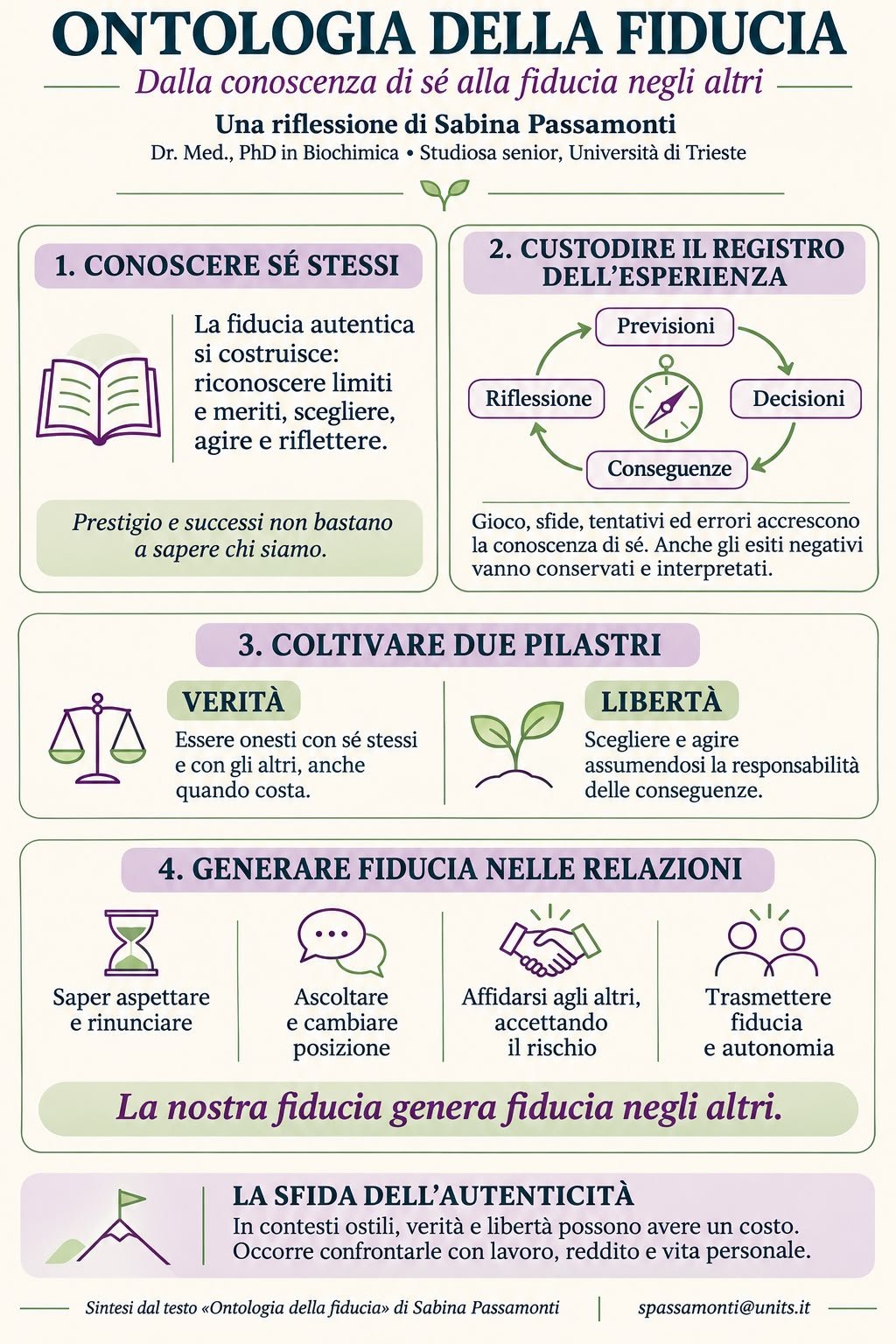
We grow up keeping the accounting record of our forecasts, decisions, consequences, and effects. This accounting is the objective basis on which self-confidence can grow. If some of our experiences are transferred into oblivion, for example, for convenience (we don't like them) or for distraction (we don't stop to reflect on them, to digest them), our record will be smaller.
One always learns too late that holding on to the memory of negative experiences would help us rejoice when certain situations improve and we can be satisfied with them. This is how it happens in the daily life of scientific research: never discard or even erase a negative result, because it is still a sign to be archived and interpreted later.
Therefore, trust will grow under certain conditions. Not if we have made the right or wrong choices, appropriate or inappropriate, but if our accounting ledger is true, objective, and inherently reliable and constantly updated. Years go by, and the ledger gains a certain function of future prediction.
What is needed to keep our accounting ledger in order and therefore increase our capital of trust:
- love for the truth that surpasses self-love
- love for freedom which is the tool to approach the truth (freedom is choice and responsibility)
The love for truth makes us choose to be honest with ourselves and towards others.
Many times it is not possible to be honest, there are many brakes or distractions and everyone can do their own examination of conscience. I can tell you about myself... in my professional life, I have not dedicated enough time to weaving "light" but ultimately useful relationships, I did not show myself because I preferred to be known, but showing oneself is also important: it is a sign of self-confidence and meets the other's need to trust instinctively.
The love for truth leads us, indeed pushes us, to understand that being honest is the key factor to know oneself and the world, and therefore, among many other things, also to build trust. The love for truth is much more important than prevailing, or succeeding, or accumulating possessions. The love for truth becomes for us not only a logical (epistemological) and ethical matter, but ontological, of personal identity: who am I and how do I position myself in the world?
I tried this: giving up on prevailing or standing out or acquiring for the love of truth made me feel courageous and strong: it increased my self-confidence. Doing this a few times made me realize that one "survives," overcomes difficulties, and manages to accept challenges that seem too big for us.
The love for truth compels us to love freedom, that is, the determination to choose and act. In other words, the love for freedom is the need to take on responsibilities, and therefore it is not, strictly speaking, the freedom to avoid, postpone, or manipulate. The love for truth leads us to approach an authentic life, where above all one knows one's own limits and merits. Among other things, this learning sharpens critical sense and the ability to interpret or understand the world, and finally other people: it is inevitable to find in our interpersonal relationships a certain reflection of ourselves.
It is not the number of successes, hits scored, or earnings that grows our confidence. Rather, it is our ability to remain in the love of truth and freedom, which is a supreme and at the same time humble form of self-love, or a realistic and integrated identity within the greatness of the world.
The authentic way of living has immense positive repercussions on others, the people with whom we participate in social life, in the family, in the profession, and every other context. Others trust us and discover they can trust themselves. In other words, our trust generates trust in others and thus personal, material, and spiritual development.
Some consequences of the intellectual and emotional capital of trust
- A person who has confidence in themselves, for the love of truth and freedom, knows how to wait. They know how to give up, they know how to deny, they know how to wait. Why? Because they trust they will recognize and seize the next opportunity. They have learned to rely on and the deep meaning of faith.
- A person who has confidence in themselves, for the love of truth and freedom, knows how to listen to others' voices and knows how to change their own positions after listening.
- A person who has confidence in themselves knows how to trust others. They are aware that they could be wrong, they might bet wrongly on other people, but they know that if the bet were not only well-founded but also lucky, getting confirmation would be an immense good. Taking such a risk is worth it, and one can also have confidence in oneself to know how to make amends. Sometimes one fails, but it is better to have been free to fail than a prisoner of the fear of failing.
- A person who has confidence in themselves transfers it to others and others can be proactive heirs, not just passive beneficiaries.
Problems
The person who exudes self-confidence can be seen as uncomfortable. First of all, they may convey signs of their love for truth and freedom. In work communities where excellence does not prevail, but perhaps empty proclamations of excellence do, they might be hindered and even attacked. Here, one must choose whether to remain in love with the truth or to succumb. One must reckon not only with their own ethics but also with their ability to continue their profession, find another job, have an income, and balance personal life and work life.